The soul beyond the canvas
Everything begins with an intense, overwhelming emotion. An emotion that doesn't fade in a moment, but faithfully accompanies me throughout the entire creative journey.
Where does an idea come from? Sometimes it surfaces from a dream, vivid and urgent. Other times it stems from my own deep thought, or comes to life from a story told by a person I met by chance. Or simply, it is born while walking down the street, stopping where others walk straight past.
When I stop to look at an old wooden door worn by time, I don't just see wood and rust. I see five generations of lives that have crossed that threshold. I hear their stories, their voices, their secrets. I see a world that is silently disappearing, erased by the rush to "renew" and "modernize." A new aluminum door will take the place of the ancient wood; a new, sterile electrical meter will replace the old, encrusted one.
I paint to save these memories. I paint what is no longer there and what will never be again. And in that precise instant, when the deep meaning reveals itself to my eyes, the artwork is already finished in my mind. I can already sense the dimension, feel the exact fall of the light, touch the texture of the matter with my eyes.
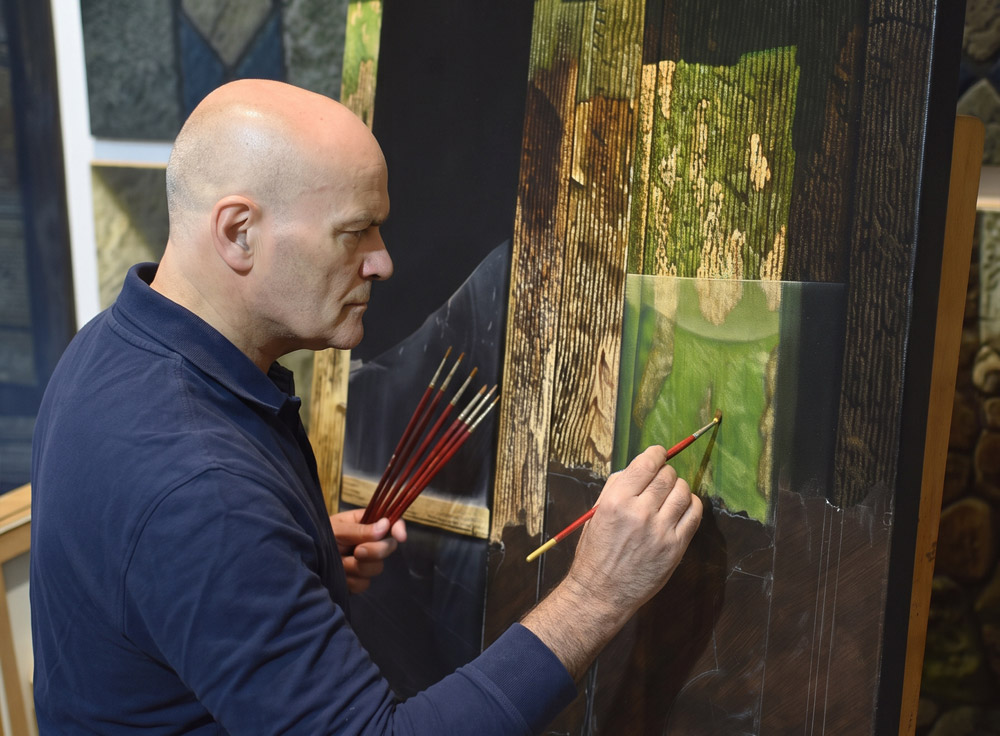
An Exclusive Bond
I let a few days pass in the silence of my atelier, to let this vision settle in my soul. Only then does the true confrontation with the canvas begin.
There is one rule I never break: I work on only one artwork at a time. I never paint two pictures simultaneously. It is an exclusive, total, and absolute immersion.
This journey requires four to twelve months of daily work from me. I do not experience this dilated time as a burden, but as a vital necessity: I need it to converse with the subject until I reach its essence.
And every subject has its own rules. A still life grants me slight interpretive breaths; the naked body, however, forgives me nothing. Every curve, every muscular tension, every reflection on the skin must be millimeter-perfect. On the human body, I have no margin for error.
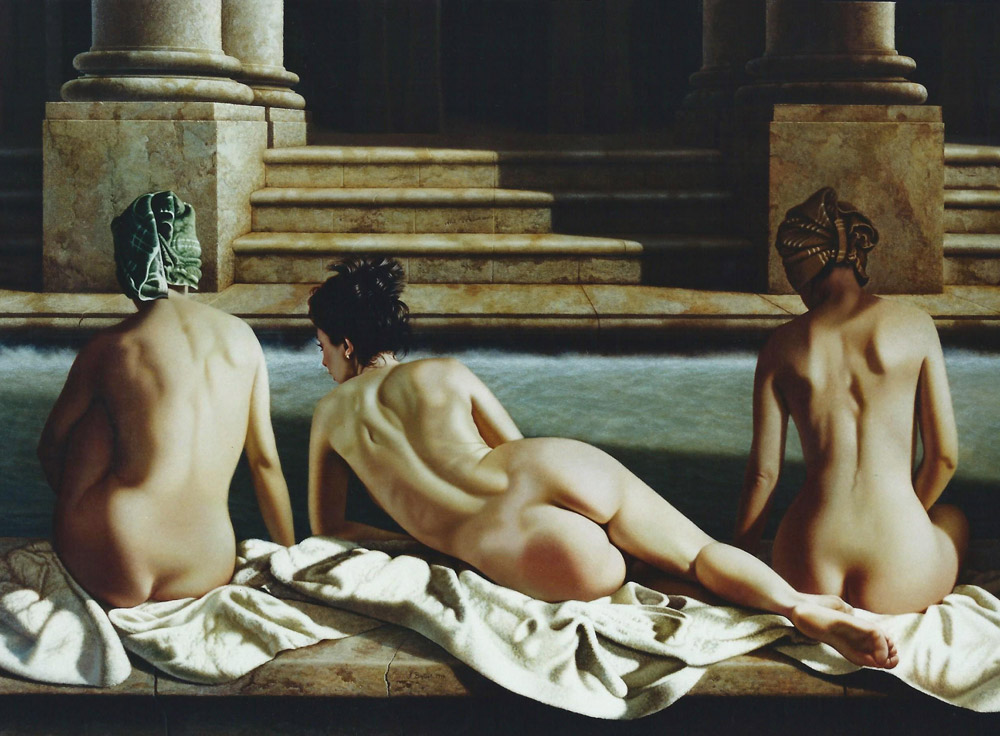
Matter as an Extension of Thought
To sustain this long physical and emotional journey, I need materials that feel deeply mine, tools that become a natural extension of my hands. I use colors and supports with which I feel in harmony, capable of restoring the tones exactly as I see them in my inner vision.
When I paint with oil, my choice always falls on fine-grain Gallery canvas, which I mount on artisanal frames built here in Umbria by master craftsman Leonardo Scaramucci. On my palette, I bring the warm earths and vibrant colors of Winsor & Newton, Lefranc, Rembrandt, and Puro Maimeri. I lay them down with my trusted Borciani e Bonazzi Kolinsky sable brushes. Only at the very end is the painting protected with a varnish that will preserve its soul over time.
If the initial emotion calls me toward Pastels, my touch becomes different. I work on Clairefontaine Pastelmat paper, carefully blending the pigments of Schmincke and Carbothello, and then protecting the artwork under anti-reflective Museum Glass and acid-free backing.

My Final Act of Care
My responsibility does not end with the last brushstroke. Accompanying the artwork to its new home is my final act of devotion.
The packaging is designed to protect months of life: if the canvas travels rolled, I place it inside an impenetrable system of two concentric tubes. If it travels stretched, it rests safely inside custom-built certified wooden crates, designed to cushion every impact.
And inside, alongside the living scent of the paint, I always include the Certificate of Authenticity. It is the final signature that closes this unrepeatable journey, born on the street in front of an old door, and arrived right here, before your eyes.